

There are plays that tell you a story, and then there are plays that pull you so deeply into a world that you feel as though you are a fly on the wall, eavesdropping on familiar lives, lives that might have existed long before you arrived.
Suzan-Lori Parks’ Pulitzer Prize-winning Topdog/Underdog is firmly in the latter category.
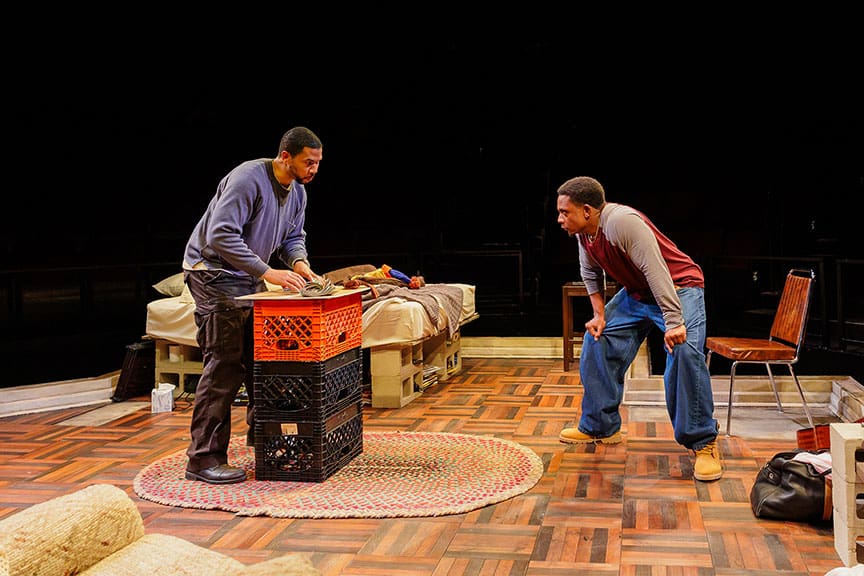
Now playing at The Old Globe through October 18, this modern American classic places siblings, wounded brothers—Lincoln and Booth—in a cramped apartment and lets their complicated relationship slowly unravel before us. In this remarkably intimate production, directed by Steve H. Broadnax III, the entire world of the play rests on the shoulders of two actors: Elijah Jones and Alano Miller.
And they are extraordinary.
Presented in the round at the Sheryl and Harvey White Theatre at the Conrad Prebys Theatre Center. The audience isn’t simply watching Lincoln and Booth; we feel as though we have been invited into their private space, close enough to catch every look, pause and shift in body language.
There are only two actors.
They are more than enough. They are brilliant!
Jones plays Booth, the younger brother, a hustler and aspiring three-card-monte expert whose swagger is matched by an immature need to prove himself. He is a booster, a schemer and a dreamer, living in a bleak one-room apartment and surviving largely on bravado.
Jones makes Booth instantly watchable. His humor and charisma make the character likable, even when his behavior is questionable. But Jones wisely refuses to make Booth merely a charming street hustler. Beneath the cockiness is insecurity, beneath the humor is pain, and beneath the bravado is a young man still trying to understand what it means to have abandonment issues.
Then Lincoln enters.
Played by Alano Miller, the older brother initially seems to represent everything Booth is not. Lincoln has a job. He wants to live honestly. He brings home his paycheck and tries to contribute to the household. He appears to be the responsible one.
But Parks gives Lincoln one of the play’s most unsettling ironies: his job requires him to portray Abraham Lincoln in blackface.
Miller plays the contradiction beautifully. Lincoln is trying to maintain his dignity while performing a degrading caricature for a paycheck. His exhaustion is palpable, but so is his determination to convince himself that he is doing the right thing.
It is a quietly devastating performance.
What makes Miller and Jones so effective, however, is not simply what each actor does individually. It is what happens when they are together.
The brothers’ conversations are filled with teasing, insults, challenges and memories. Their exchanges can be funny one moment and deeply uncomfortable the next. A seemingly harmless conversation can suddenly expose an old wound. A joke becomes triggering. A card trick becomes a contest for dominance.
Jones and Miller understand the rhythm of brotherhood—the peculiar ability siblings have to move from affection to irritation to competition without warning.
Their performances are built on those shifts.
The brothers love one another, but they also measure themselves against one another. Each wants what the other appears to possess. Each believes the other has been given some advantage in life. And each carries resentments that have been accumulating for years.
That tension is heightened by the brothers’ names.
Lincoln and Booth are supposedly nicknames given to them by their parents, but the historical association between Abraham Lincoln and John Wilkes Booth casts a dark shadow over everything that follows. The names are more than a clever theatrical play on historical figures. They become a quiet warning, suggesting that this brotherly rivalry may have consequences neither man can control.
Parks is equally effective in what she chooses not to reveal.
The brothers were abandoned by their parents—Lincoln at 16 and Booth at 11—but the circumstances remain frustratingly incomplete. We hear about their absent parents, Lincoln’s estranged wife Cookie and Booth’s girlfriend Grace, but these people never appear.
That absence matters.
Cookie and Grace exist only through the brothers’ recollections, just as the parents exist largely through fragments of memory. We are left to wonder how much these men actually know about the people they claim to love, and how much of their own histories they have constructed to survive.
Even the apartment seems to tell a story.
A bed. A chair. A card table. And, that’s it.
It is Booth’s space, yet Lincoln lives there too. The physical confinement mirrors the emotional confinement of their relationship. Neither brother seems capable of completely leaving the other behind.
And that is where Broadnax’s direction becomes especially effective.
There is no elaborate spectacle to distract from the actors. The production trusts Parks’ language and, most importantly, trusts Jones and Miller. Their faces, movements and silences become part of the dialogue.
By the second scene, the playful competition has darkened considerably. The three-card-monte game, which initially seems like a source of humor and fascination, begins to take on greater significance. Winning is no longer simply about cards. It is about power. It is about masculinity. It is about who gets to be the topdog—and who is forced into the role of underdog.
It is at this point in the production that the title becomes increasingly revealing.
Neither brother is willing to remain the underdog.
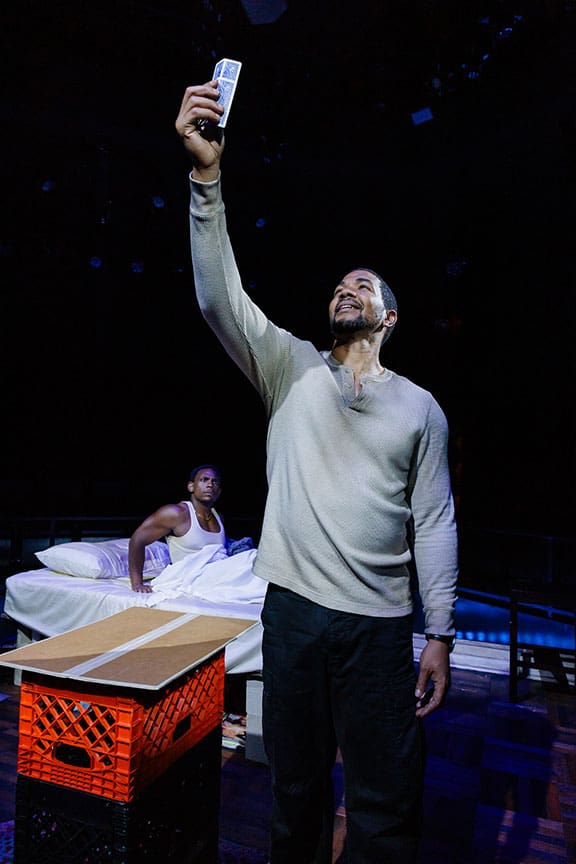
As the tension builds, the play becomes less about survival in the literal sense and more about psychological survival. Who has been wronged? Who deserves more? Who has sacrificed more? Who has the right to determine the future?
And eventually, the competition becomes something much darker.
Jones’ Booth becomes increasingly volatile, while Miller’s Lincoln reveals layers of anger and vulnerability that have been carefully contained. The two performances seem to feed off one another, each actor raising the emotional stakes without ever losing sight of the humanity beneath the conflict.
That is the real triumph of this production.
Neither brother is simply the hero or the villain. Neither is entirely innocent. Both are products of abandonment, poverty, pride and circumstance. And both are capable of hurting the person they love most.
Watching Jones and Miller navigate that contradiction is riveting.
There are moments when you may laugh with these brothers. There are moments when you may become frustrated with them. And there are moments when the room becomes so tense that the audience seems to hold its collective breath.
That is the power of live theater.
Topdog/Underdog is a dark, funny and ultimately haunting exploration of brotherhood, identity, abandonment and the complicated ways people fight to survive. But at The Old Globe, the play’s greatest weapon is not the text alone.
It is the extraordinary chemistry between Elijah Jones and Alano Miller.
They don’t simply perform Lincoln and Booth.
They inhabit them.
By the end, the audience has witnessed two men who are simultaneously brothers, rivals, survivors and, in many ways, prisoners of the same past. Jones and Miller make that relationship so immediate and visceral that we feel less like an audience and more like witnesses to something deeply private.
This is theater at its most intimate—and its most unsettling.
Topdog/Underdog is now playing at The Old Globe’s Sheryl and Harvey White Theatre at the Conrad Prebys Theatre Center through October 18.
See it for Parks’ brilliant writing. See it for Broadnax’s assured direction.
But most of all, see it for Elijah Jones and Alano Miller.
They are, quite simply, the reason this production hits so hard.
For ticket information CLICK HERE.